
Loop
Loop is the build → judge → fix app, at /loop.
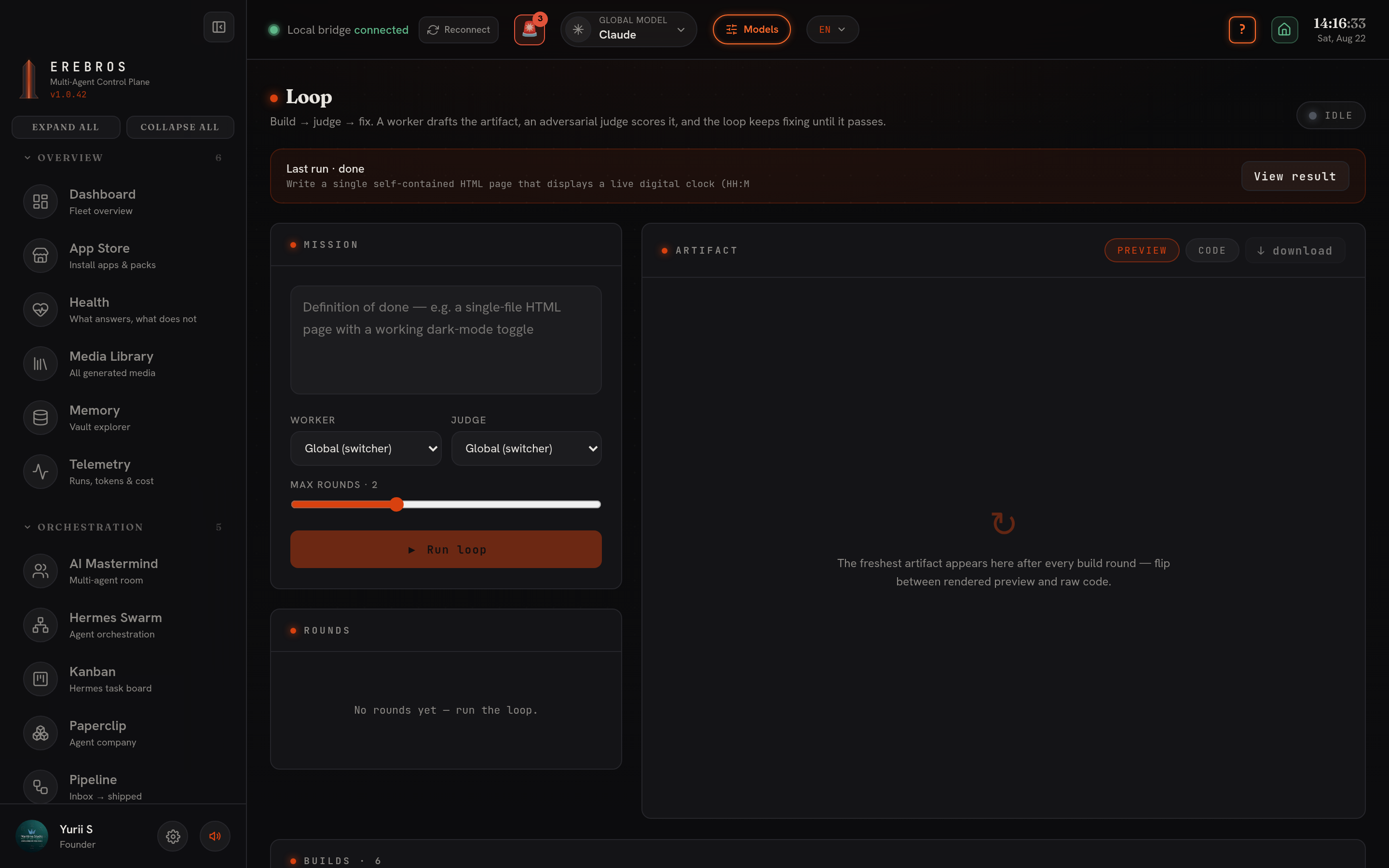
What it does
Section titled “What it does”You give Loop a goal. A worker drafts a single-file HTML artifact, an adversarial judge scores it, and the loop keeps fixing the artifact until it passes, or until it hits the maximum number of iterations you set.
Key functions
Section titled “Key functions”- Worker and judge models, each defaults to Global (switcher) but can be set per-run to any model (Claude, Codex, local, and so on).
- Max iterations, cap how many build-judge-fix rounds run before Loop stops.
- Saved builds, browsable with live preview.
Setup and dependencies
Section titled “Setup and dependencies”Loop runs on the global model (Claude by default; switch it in the top bar). If the global model is a CLI, that CLI must be installed and logged in, for example the Claude Code CLI (claude), Grok Build CLI (grok), or others.
To run the judge locally, install Ollama and pull a model (for example ollama pull gemma2); Loop can then use a local judge with no API cost.
Where output goes
Section titled “Where output goes”Saved builds are kept and browsable with live preview inside the app. On disk they
live under ~/.erebros/loop-builds/.
- Set a sensible max-iteration cap so a run that cannot pass the judge stops cleanly.
- Mixing models, a strong worker with a strict, cheaper judge, is a good way to control cost.